Hey Reader,
Southeast Asia's venture capital collapse forced its best growth companies toward profitability, and left them undervalued for whoever has the patient capital to buy.
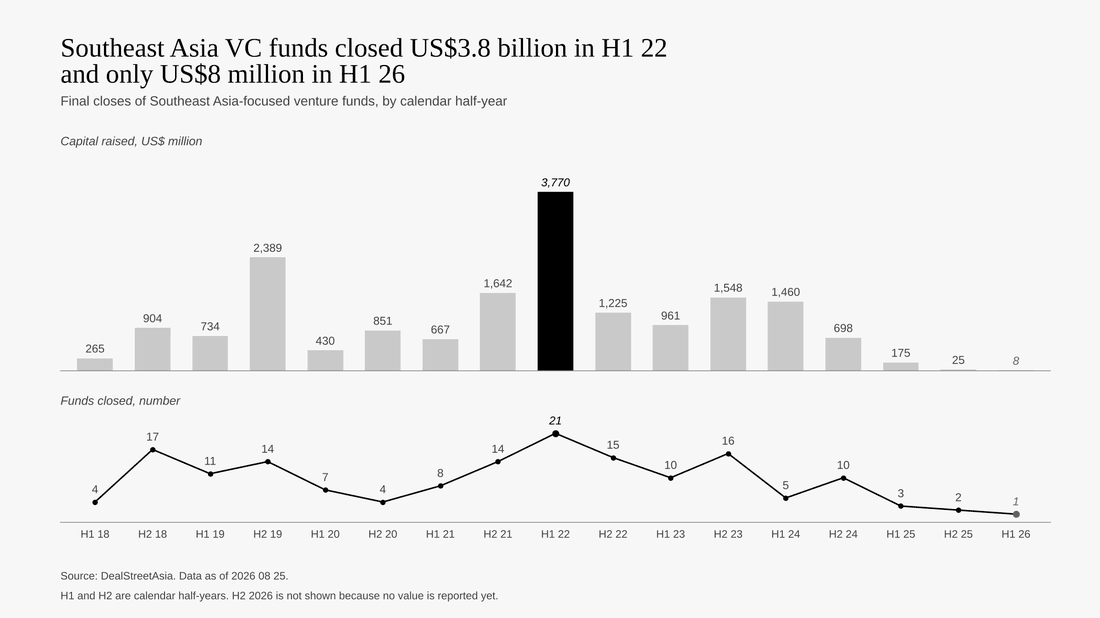
I was looking at a slide from the 10th Asia PE-VC Summit this week. Southeast Asia-focused VC funds closed 3.8 bnUSD across 21 funds in the first half of 2022. By the first half of 2026, that was 8 mUSD across a single fund.
That chart reads like a shut down of an entire asset class, but what it is actually illustrating is a funding shortfall that forced an entire growth company ecosystem toward profitability faster than it would have chosen on its own.
The local market peaked with the rest of the world, and never recovered
The Southeast Asia VC market peaked in 2022, in line with every other VC market globally, and then tech valuations dropped 70% to 90% from there.
The difference here is that most Southeast Asian VC fund managers were only on their first or second fund when that happened, and most of their capital had been deployed near the peak. That left them with no track record to raise their next fund on, and no more money came in behind them. There were also a handful of well publicised blow-ups, which every region gets, it is just that this region's overall track record is still short enough that a few bad cases can sink a fund manager's ability to raise again.
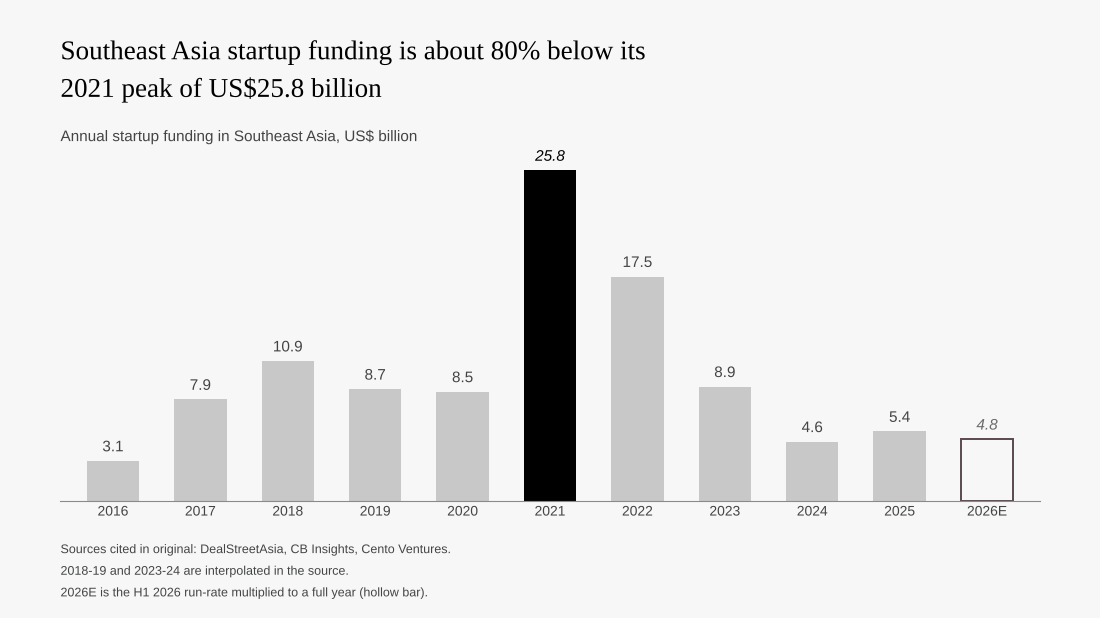
The result is in the second chart. Regional startup funding went from 3.1 bnUSD in 2016 to a peak of 25.8 bnUSD in 2021, fell to 4.6 bnUSD in 2024, the lowest in a decade and roughly back to 2016 levels, and only recovered to 5.4 bnUSD in 2025.
What actually happens to a company when the VC money disappears
A funding collapse usually changes what a company has to do to survive, rather than killing it outright. Most readers treat it as the latter.
Most companies that would have raised a growth round instead got pushed to profitability sooner, and had to taper growth to get there. What you are left with is an undervalued ecosystem, mostly break-even or profitable, but without the mega-growth profile that VC was looking to fund in the first place.
You can see this directly in the Southeast Asian e-commerce enabler industry as an example. A wave of players went under post-2022 when the VC capital evaporated. Only a handful are left standing per country, and they are mostly delivering profitable growth, because profitability was the only path left once the next round stopped being a recurring option.
Why the VC structure itself does not fit most of this region
Even people who agree the region is undervalued usually overlook why the VC structure itself does not fit it.
The classic VC fund model expects power laws to do the work, one or two investments carry the whole fund's return. That model needs a handful of businesses capable of becoming enormous. Outside the mega-verticals, e-commerce, ride hailing, digital lending, etc., most digital verticals in Southeast Asia are not big enough for that math to work. VC fund lifetimes, typically 10 years with extensions, are not built for a region that moves through volatile multi-year cycles the way this one does either.
What this region's companies actually need is patient, permanent capital that can survive the volatility instead of needing to exit on a fund's clock, not another VC fund racing the same ten year timer. You need diamond hands, as they say in crypto.
What to do with this
If you are an allocator, read that VC funding chart as a statement about who is left to fund these companies, not about whether they are still good businesses. The capital willing to fund them on a 10-year power-law model has mostly left, and the businesses still standing had to prove they could survive without it.
That is a different, and in my view better, starting point for a long-term investor. Ask where the next marginal round of capital for this region might actually come from (my guess is internal cash flows, corporate strategic buyers and roll-ups), given what you now know about fund lifetimes and vintage years. It's also worth looking inwards and asking yourself if your capital/portfolio as well as investment decision making and governance is structured to be the answer to that question, or whether it is structured the same way the VC funds that just left were.
Christopher B. Beselin
Investing, compounding & exiting
Christopher B. Beselin is the Chief Investment Officer of Endurance Capital. The views & opinions expressed in this newsletter are for informational and educational purposes only and should not be considered investment advice.
PS. If you're a qualified professional investor and you're not sure where to begin structuring your emerging market investment exposure, feel free to schedule a 1-to-1 emerging market strategy call with Christopher B. Beselin via this link. DS.